- 2%Intra-assay variation
- 10%Inter-assay variation
- R² = 0.984Linearity across the biologic range
- 18 monthsLyophilized stability at −20 °C
Project overview
Cardiovascular disease remains the leading cause of death and disability worldwide. Antithrombotic treatments such as dual antiplatelet therapy (DAPT) reduce ischemic cardiovascular events by inhibiting platelets, but their use can increase bleeding risk. Physicians must carefully balance ischemia and bleeding risks to make treatment decisions.
Prolocor has a goal to help clinicians assess thrombosis risk and personalize antiplatelet therapy with a novel FcγRIIa test. FcγRIIa amplifies platelet activation, and high platelet FcγRIIa (pFCG) expression correlates with an increased risk of recurrent cardiovascular events, making it a valuable biomarker for patient stratification.
High-risk patients with elevated pFCG levels may benefit from more intensive or prolonged treatment. However, in low-risk patients, the bleeding risks of extended therapy may outweigh its benefits, making a shorter duration the safer, more effective choice.
The Prolocor pFCG™ test quantifies FcγRIIa levels using a novel 5G1 antibody to bind FcγRIIa on previously fixed platelets, addressing issues with platelet degradation during in vitro analysis and improving assay precision.¹
However, developing a reliable diagnostic test requires robust baseline assessment and consistent controls. Biological controls present challenges, including donor variability, limited availability, and stability issues, which complicate assay development, validation, and routine clinical implementation.
Customer challenges
Achieving assay precision is critical in bioanalysis and diagnostics to generate reliable prognostic results for patient treatment. However, biological variability is a diagnostic challenge: platelets from different donors may express different levels of a given protein or respond differently to stimuli. When researchers rely on biological samples as controls, this variability makes it difficult to establish clear and reproducible benchmarks during assay development.
Furthermore, unlike blood, plasma, or serum, platelets cannot be ‘spiked’ with a given amount of a specific protein. This makes precision and accuracy more difficult to assess.
Solution
To overcome these challenges, Prolocor integrated Slingshot Biosciences’ TruCytes® FcγRIIa-conjugated cell mimics as standardized assay controls for their pFCG™ test validation studies. TruCytes® provided a stable, reproducible alternative to biological specimens (fixed platelets) to improve assay precision and accuracy, and to assess the test’s linear range. Implementation of TruCytes® as internal assay controls improved test consistency across different sample batches and strengthened the reliability of the pFCG™ test across diverse clinical applications.
Slingshot Biosciences leverages biochemistry, high-precision manufacturing, and polymer chemistry to engineer cell mimics with tunable size, morphology, and biochemical properties that can be matched to any cell type.
Using this technology, Slingshot produced custom TruCytes® cell mimics conjugated with purified FcγRIIa at different protein loading levels that span the biologic range of ~500 to 8,000 molecules of FcγRIIa per cell mimic. This represents a broad range of protein expression values across biological platelet samples, from the low values seen in healthy subjects to the higher values seen in patients with cardiovascular disease and cancer.
An accelerated stability study conducted by Slingshot demonstrated that product stability is maintained for 18 months when stored in lyophilized form at −20 °C. Upon reconstitution in phosphate-buffered saline with 0.2% bovine serum albumin, TruCytes® remained stable for 30 days at 4 °C.
Results
Assessment of assay precision
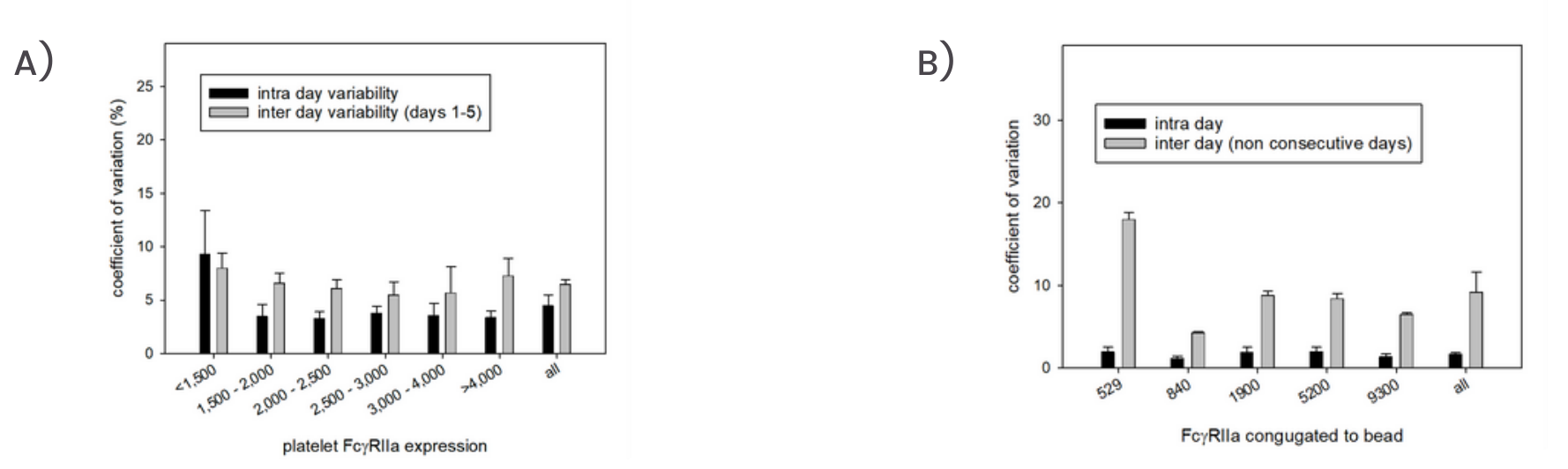
pFCG™ test validation with biological specimens (fixed platelets) showed an intra-assay coefficient of variation (CV) of 2.1 ± 0.1% and inter-assay CVs of 4.5 ± 1% (intraday) and 6.5 ± 0.4% (up to 5 days post-fixation) (Figure 1A). In comparison, the inter-assay CVs were 2 ± 0.6% (intraday) and 9.9 ± 2.1% (interday) using the TruCytes® (Figure 1B).
Assessment of assay accuracy
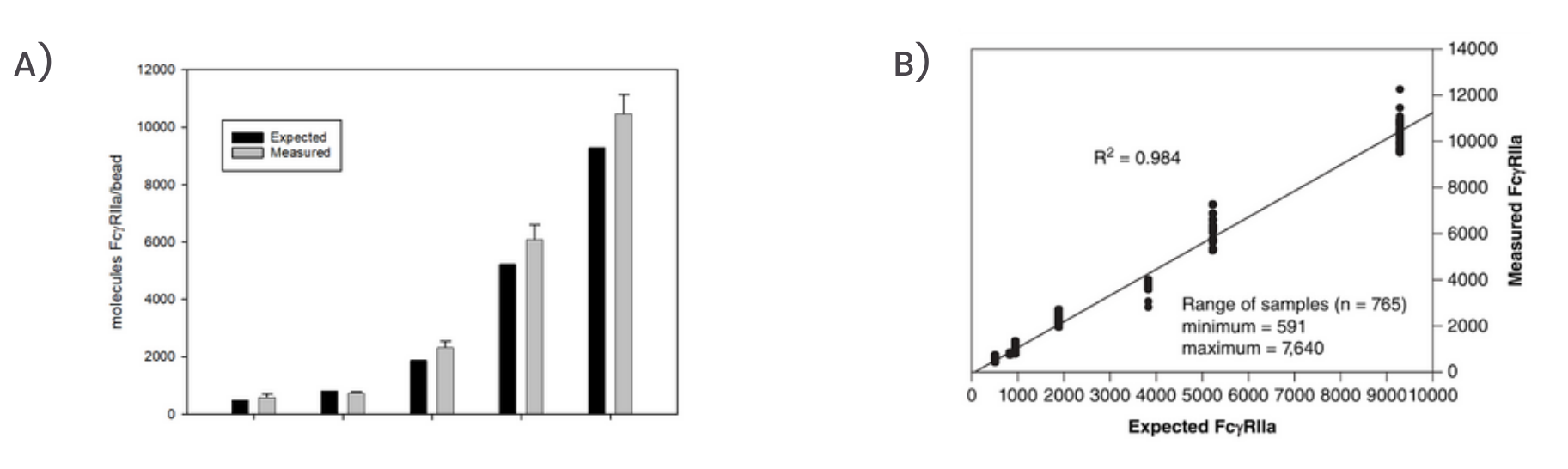
Figure 2 demonstrates the use of TruCytes® to evaluate the accuracy and linearity of FcγRIIa quantification. The Prolocor pFCG™ test demonstrated excellent accuracy and linearity across biologic expression levels with a linear regression of R² = 0.984.
Customer outcome
The Prolocor pFCG™ test offers rapid and accurate FcγRIIa quantification on fixed platelets via flow cytometry. Analytical validation studies demonstrate the test’s high accuracy, with intra-assay variation at just 2% and inter-assay variation at 10%, both well below the FDA’s acceptable threshold of 25%.
The inclusion of FcγRIIa-conjugated TruCytes® as internal controls provides a significant advantage over traditional biological controls. TruCytes® offer a stable and reproducible alternative that outperforms biological specimens, enabling more consistent and precise quantification of FcγRIIa. This enhanced consistency and reliability make TruCytes® a key component for maintaining high precision and accuracy in the Prolocor pFCG™ test, further solidifying its value as a prognostic tool in clinical settings.
As clinicians seek better tools for informed decision-making, the prognostic capabilities of the Prolocor pFCG™ test are a critical asset for enabling personalized cardiovascular disease treatment that prioritizes patient safety.
References
- Schneider, David J et al. “Assessing prognosis by quantifying FcγRIIa on fixed platelets.” Bioanalysis vol. 16, 19–20 (2024): 1025–1032. doi:10.1080/17576180.2024.2395706
“We want to thank our partners for developing the novel TruCytes™ cell mimics that are central to the test and pivotal to demonstrating the accuracy and power of this test.”
Stay Updated
Subscribe to receive product updates, new resources, webinars, and application notes.
Get the full case study
Download the complete write-up, with methods, figures and references, to share with your team.
Download PDF