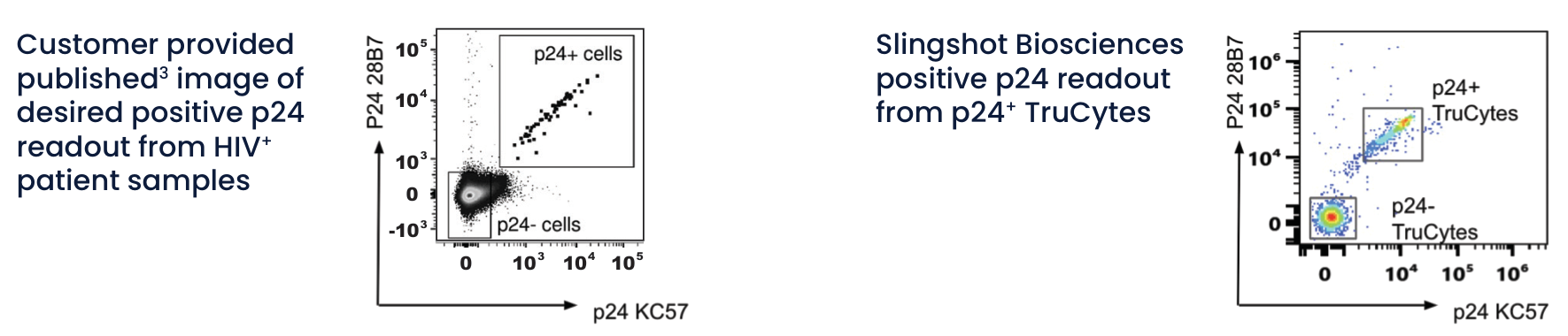
- 10⁴–10⁵ MFITarget p24 expression range matched
- 3 markersp24, CD3 and CD4 on one T cell mimic
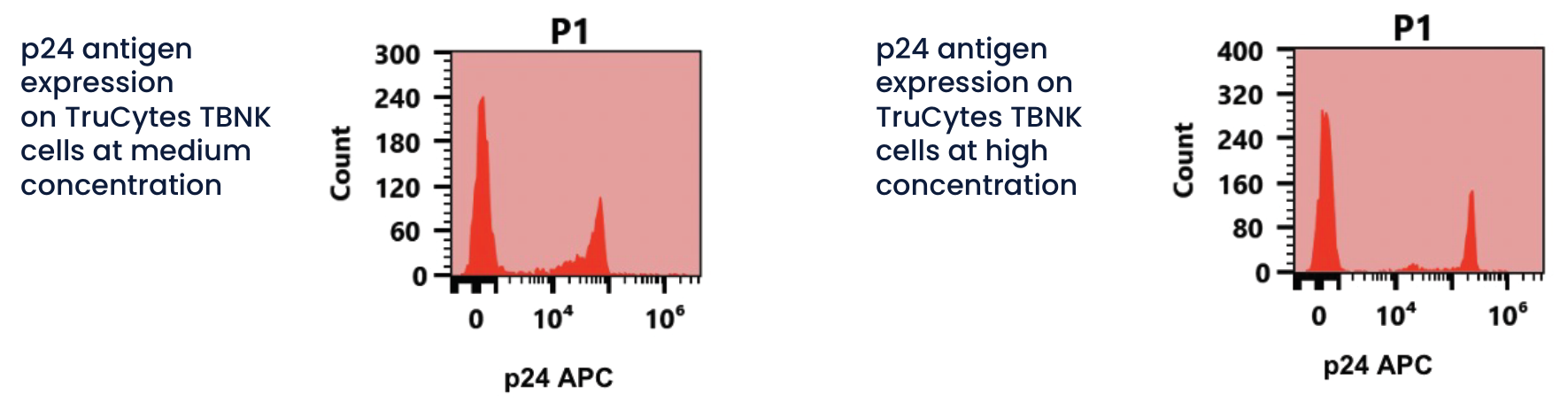
- 2 levelsp24 expression at medium and high concentration
Project overview
A Fortune 100 pharmaceutical company came to Slingshot Biosciences, Inc. to explore assay strategies for detecting the reduction in HIV reservoir proviruses in patients living with HIV. They were interested in using HIV-1 p24 expression as a marker for translation-competent HIV-infected cells.¹ Flow cytometry provides a practical and rapid way to monitor anti-retroviral therapy and better predict disease progression compared to laborious methods such as PCR.²
However, the traditional approach of using HIV-infected cells as reference controls in flow cytometry studies presents enormous bio-safety risks to lab personnel, which results in the need for costly bio-safety equipment and segregated lab space. Moreover, patient donor blood can introduce variability and limit consistency in results when used as a reference control, as no patient sample will be exactly the same. Low or variable expression of p24 antigen in patient samples also poses an additional challenge to reproducible results.
To address these challenges, Slingshot Biosciences partnered with the pharmaceutical company to engineer a p24-expressing, non-infectious synthetic T cell mimic that could safely, reproducibly, and conveniently be used as a cellular reference control for detecting p24 antigen-positive T-cells in HIV+ patients.
Customer challenges
- The company’s research into HIV treatments requires the use of translation-competent HIV-infected cells commonly sourced from viremic HIV+ blood donors, thereby presenting biohazard risks and limitations around sample variability.
- The need for a consistent control with high (around 10⁴ to 10⁵ mean fluorescence intensity) p24-antigen expression in a similar scatter profile to donor blood samples.
- The need to reduce significant time-consuming efforts to acquire and store viremic HIV+ donor blood or create biological p24-antigen-expressing cell lines. This often includes bridging studies that require extensive regulatory paperwork and reporting.
Solution
Slingshot Biosciences produces TruCytes® synthetic cells with tunable size, morphology, and biochemical profiles that can be matched to any cell type. Using this technology, the Slingshot team produced a synthetic T cell mimic expressing p24, CD3, and CD4.
As shown in Figure 1, Slingshot Biosciences was able to match the desired antigen expression levels of p24.³
The Slingshot team also generated varying concentrations of p24 with different antigen expression levels on p24+ TruCytes (Figure 2).
Outcomes
The availability of Slingshot’s engineered T-cell p24 antigen expressing synthetic cells eliminated the need to use HIV+ patient donor blood as an assay reference control. These custom synthetic cells improved safety in the laboratory by reducing opportunities for accidental infection. The previous method of analysis required the use of HIV+ viremic T cells and involved extensive processing, including a magnetic enrichment step to isolate T cells from whole blood samples. This process takes significant effort and time which together bears high reagent costs.
Benefit to client
Slingshot p24+ synthetic T cell mimics are lyophilized synthetic cells that are quickly reconstituted in a buffer, saving considerable time, effort, and cost. In addition, operator safety was improved by eliminating the risk of infection during processing and handling.
After validation, the customer purchased multiple large batches of custom p24+ synthetic T cell mimics. The market-leading lot-to-lot consistency of Slingshot’s synthetic cell mimics has the added benefit of yielding a stable signal in their assays over time. This eliminates the need for bridging studies and cell line maintenance, a vast improvement over the traditional cell-based reference material supply chain, which is subject to variable marker expression as seen among blood samples from different donors or cell lines.
The Slingshot advantage
- Level-up with truly cell-like performance
- Our synthetic cells match the optical, fluorescence, and biochemical features of cells
- Customizable to any cell population
- Precisely control the level of key biomarkers
References
- Cole, B., Lambrechts, L., Gantner, P. et al. In-depth single-cell analysis of translation-competent HIV-1 reservoirs identifies cellular sources of plasma viremia. Nat Commun 12, 3727 (2021). https://doi.org/10.1038/s41467-021-24080-1
- Tessema B, Boldt A, König B, Maier M, Sack U. Flow-Cytometry Intracellular Detection and Quantification of HIV1 p24 Antigen and Immunocheckpoint Molecules in T Cells among HIV/AIDS Patients. HIV AIDS (Auckl). 2022;14:365-379. https://doi.org/10.2147/HIV.S374369
- Pardons M, Baxter AE, Massanella M, Pagliuzza A, Fromentin R, Dufour C, et al. (2019) Single-cell characterization and quantification of translation-competent viral reservoirs in treated and untreated HIV infection. PLoS Pathog 15(2): e1007619. https://doi.org/10.1371/journal.ppat.1007619
Stay Updated
Subscribe to receive product updates, new resources, webinars, and application notes.
Get the full case study
Download the complete write-up, with methods, figures and references, to share with your team.
Download PDF