- 99.3–100.5%Recovery of nominal EGFR+ values
- 60–75%Estimated cost savings from reduced development costs
- 3 levelsEGFR+ frequencies: low, medium and high
Project overview
Flow cytometry plays a significant role in the development and clinical implementation of cell therapies, from phenotypic characterization to quality control. In cell therapy development, flow cytometry enumeration of transduced CAR T-cells is achieved by detecting a surrogate transgene marker. Surrogate transgene markers are genes that are co-expressed or co-introduced with the therapeutic gene. These markers serve as easily detectable signals indicating the presence of the therapeutic gene.
Quality control labs such as Fred Hutch Cellular Processing Facility QC lab (CPF QC) use in-house transduced CAR T-cells for validating flow cytometry panels and often as controls for each assay. However, significant lot-to-lot variability and unknown long-term stability of these human control cells limit standardization, reproducibility and comparability of the assay over time. To address these challenges, Slingshot Biosciences partnered with Fred Hutch CPF QC to engineer custom CD3 T cell mimics with varying percentages of expression of the common CAR transduction marker epidermal growth factor receptor (EGFR) to validate their CAR T cell flow cytometry assays.
Customer challenges
In cell therapy, where novel constructs like chimeric antigen receptors are being used, finding appropriate controls that are specific and relevant can be challenging. The Fred Hutch CPF QC team struggled to find controls that demonstrated consistent results over time and could be readily available without introducing variability through development steps.
In addition to the inconsistent and fragile nature of biological controls, developing and maintaining in-house QC controls is time consuming, resource intensive and costly. We estimate that implementing cell mimics could result in 60-75% cost savings by reducing development costs.
The controls that the Fred Hutch CPF QC team develops are generated from healthy donor material and must be transduced with the viral vector much like the actual CAR T product in engineering runs which are also used to generate final product stability aliquots.
Solution
In this study, Fred Hutch custom-ordered synthetic T cell mimics with different EGFR+ population frequencies (10% low, 30% medium, and 70% high) from Slingshot Biosciences, Inc. They then conducted flow cytometry analysis using the standard CPF QC staining procedure on these EGFR+ T cell mimics.
| Percentage of recovery | Cetuximab-AF488 | Cetuximab-PE |
|---|---|---|
| Mimetic 10% EGFR+ | 99.5% | 100.1% |
| Mimetic 30% EGFR+ | 100.4% | 99.3% |
| Mimetic 70% EGFR+ | 100.5% | 100.2% |
Table 1: Precise detection of EGFR+ T-cell mimic using two fluorescent conjugated antibodies. Percentage of recovery = (experimental value / nominal value) × 100.
The Fred Hutch team achieved a 100% recovery of nominal values using PE and AF488-conjugated Cetuximab.
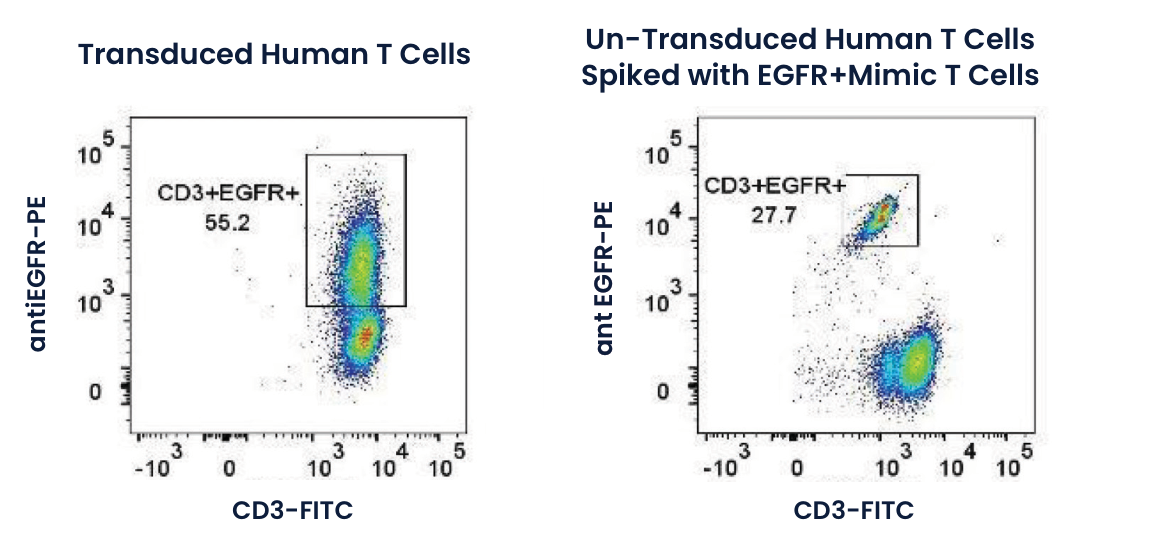
Notably, when they introduced these EGFR+ T cell mimics into human enriched T-cells, they observed uniform EGFR expression (Figure 1, right image). Furthermore, there were no significant differences in CD3 expression between human T-cells and transduced CAR-T cells (Figure 1).
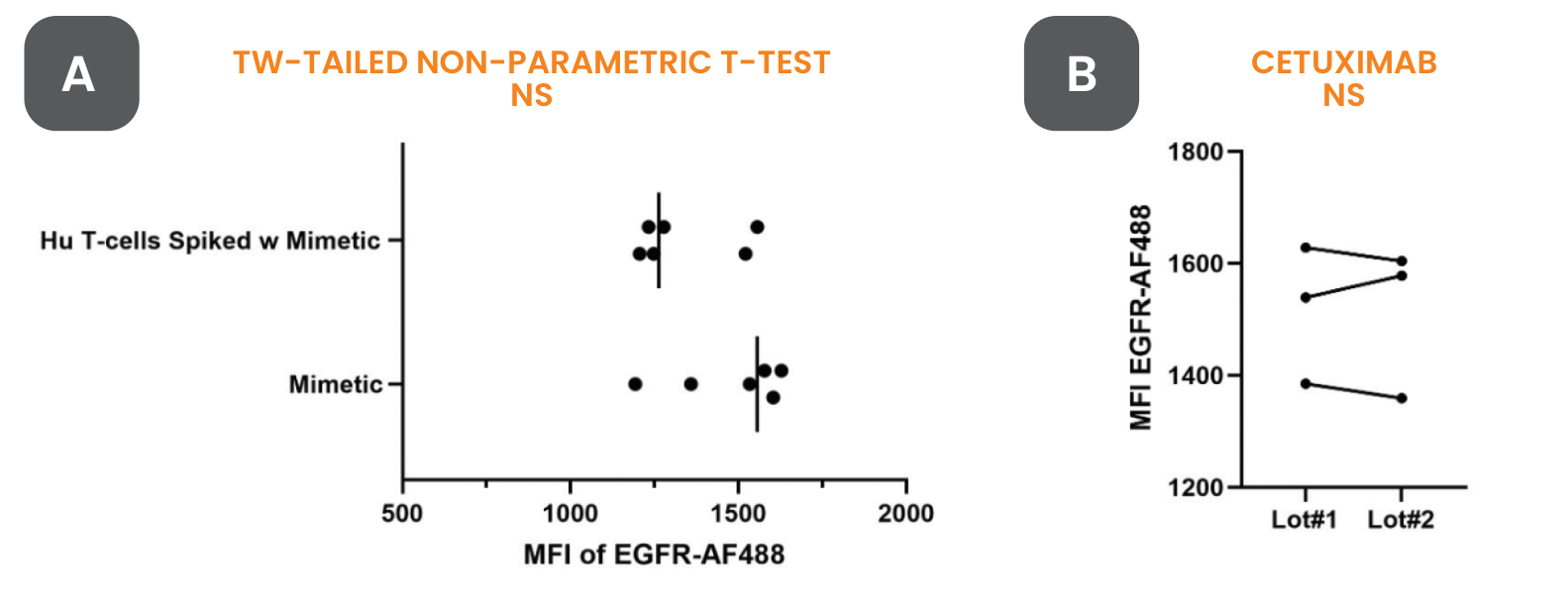
In Figure 2A, Fred Hutch measured the Mean Fluorescent Intensity of EGFR measured on the Slingshot custom T cell mimics with and without human T cells, and no significant differences were observed. In Figure 2B, they compared two different lots of AF488-conjugated Cetuximab using EGFR+ T cell mimics and found no significant differences, highlighting the consistency between the antibody lots.
Outcomes
The T cell mimics from Slingshot Biosciences showed robust lot-to-lot consistency. Unlike in-house transduced CAR T cells, which exhibited significant lot-to-lot variability, the synthetic T cell mimics provided a stable and consistent reference material. This consistency is crucial for qualifying different formats (conjugated dye) and different lots of antibodies, required for standardizing quality control flow cytometry assays used for enumeration of transduced cells in final cell products.
One of the challenges with in-house control cells was their unknown long-term stability over the lifetime of the clinical trials. In contrast, the T cell mimics were engineered to maintain stable expression of the common CAR transduction marker EGFR. This known stability ensures that the control remains reliable for an extended period, contributing to the reproducibility of assays.
The T cell mimics demonstrated specific binding to Cetuximab conjugated to fluorochromes (AF488 and PE). This specificity is essential for validating new lots of antibodies against EGFR and testing the binding capacity of antibodies conjugated to various fluorochromes. It ensures that the assays accurately reflect the intended binding interactions.
Maintaining an in-house biological control, as Fred Hutch was previously doing, can be resource-intensive, costly and subject to variability. The T cell mimics offer a more efficient alternative, reducing the need for extensive resources and reagent costs associated with maintaining and managing biological controls.
In summary, Slingshot Biosciences’ T cell mimics provided Fred Hutch with a consistent, stable, and specific reference material that effectively addressed the challenges associated with in-house control cells. These mimics offered a practical and efficient solution for validating CAR T enumeration assays, ensuring quality control, and improving the standardization and reproducibility of flow cytometry assays in the context of CAR T-cell therapy development.
Slingshot Biosciences now has this control available for purchase through Slingshot Labs.
Stay Updated
Subscribe to receive product updates, new resources, webinars, and application notes.
Get the full case study
Download the complete write-up, with methods, figures and references, to share with your team.
Download PDF