- 9 of 9Populations within single-digit %CV and %Difference
- ≤5.33%%CV across all runs
- ≤7.44%%Difference between instruments
Project overview
In cell therapy manufacturing, flow cytometry is a GMP-controlled analytical method underpinning lot release, characterization, and comparability decisions across the product lifecycle. As such, regulatory guidance requires that instruments perform consistently and reproducibly, regardless of site, operator, or instrument serial number.
Confirming that two instruments are performing identically requires a reference material that is itself standard and reproducible. Bead controls do not replicate the scatter characteristics of cells, while donor-derived biological controls cannot serve this function, as their inherent variability makes it impossible to determine whether observed differences between instruments reflect true instrument divergence or simply donor-to-donor noise.
Cellares, the first Integrated Development and Manufacturing Organization (IDMO) developing and operating integrated technologies for cell therapies, partnered with Slingshot Biosciences to evaluate the ability of ScatterBridge® synthetic hydrogel reference controls to serve as a site-independent standard for confirming inter-instrument equivalence.
Customer challenges
To support global expansion of drug products across its Smart Factory network, Cellares’ Quality Control team needed a reference material for flow cytometry assays capable of supporting a defensible, instrument-independent cross-site qualification program, where donor-matched samples must meet a pre-defined equivalency criteria across different instruments at different sites.
The reference materials themselves presented a number of challenges:
- Donor-derived PBMCs introduce biological variability that cannot be distinguished from instrument performance variation, making true instrument-to-instrument comparison unreliable
- Sourcing and qualifying donor material across geographies adds lead time and operational complexity
- Lot-to-lot variability in biological controls requires bridging studies
- Traditional polystyrene bead controls have a higher refractive index than biological cells, making them inappropriate as controls for light-scatter characteristics
- Each new instrument qualified across sites requires its own site-specific standard, preventing direct cross-site comparison
What was needed was a stable and consistent reference that could serve as a shared performance anchor across every flow cytometer in their ecosystem.
Solution
Cellares evaluated ScatterBridge® synthetic hydrogel reference controls across two flow cytometers. Nine distinct particle populations spanning the FSC/SSC space relevant to cell therapy characterization were measured across both instruments and both runs, and compared using percent coefficient of variation (%CV) and percent difference (%Difference).
| Population | FC1 Run 1 | FC1 Run 2 | FC2 Run 2 | %CV (All Runs) | %CV (Run 2 Only) | %Difference (Run 2 Only) |
|---|---|---|---|---|---|---|
| P1 | 8.56 | 7.70 | 8.25 | 5.33% | 4.88% | 6.90% |
| P2 | 8.16 | 8.28 | 8.08 | 1.23% | 1.73% | 2.44% |
| P3 | 8.25 | 8.33 | 8.59 | 2.12% | 2.17% | 3.07% |
| P4 | 10.85 | 10.88 | 11.17 | 1.61% | 1.86% | 2.63% |
| P5 | 9.81 | 10.04 | 9.32 | 3.78% | 5.26% | 7.44% |
| P6 | 9.88 | 9.46 | 9.99 | 2.86% | 3.85% | 5.45% |
| P7 | 10.86 | 11.36 | 11.20 | 2.29% | 1.00% | 1.42% |
| P8 | 11.32 | 11.85 | 11.92 | 2.80% | 0.42% | 0.59% |
| P9 | 12.78 | 12.51 | 12.63 | 1.07% | 0.68% | 0.95% |
Table 1: ScatterBridge population measurement across two flow cytometers.
All nine populations returned single-digit %CVs across each run and single-digit %Difference between instruments (FC1 = Flow Cytometer 1; FC2 = Flow Cytometer 2). Visual overlay of the FSC/SSC dot plots confirmed strong spatial concordance across the full scatter space (Figure 1).
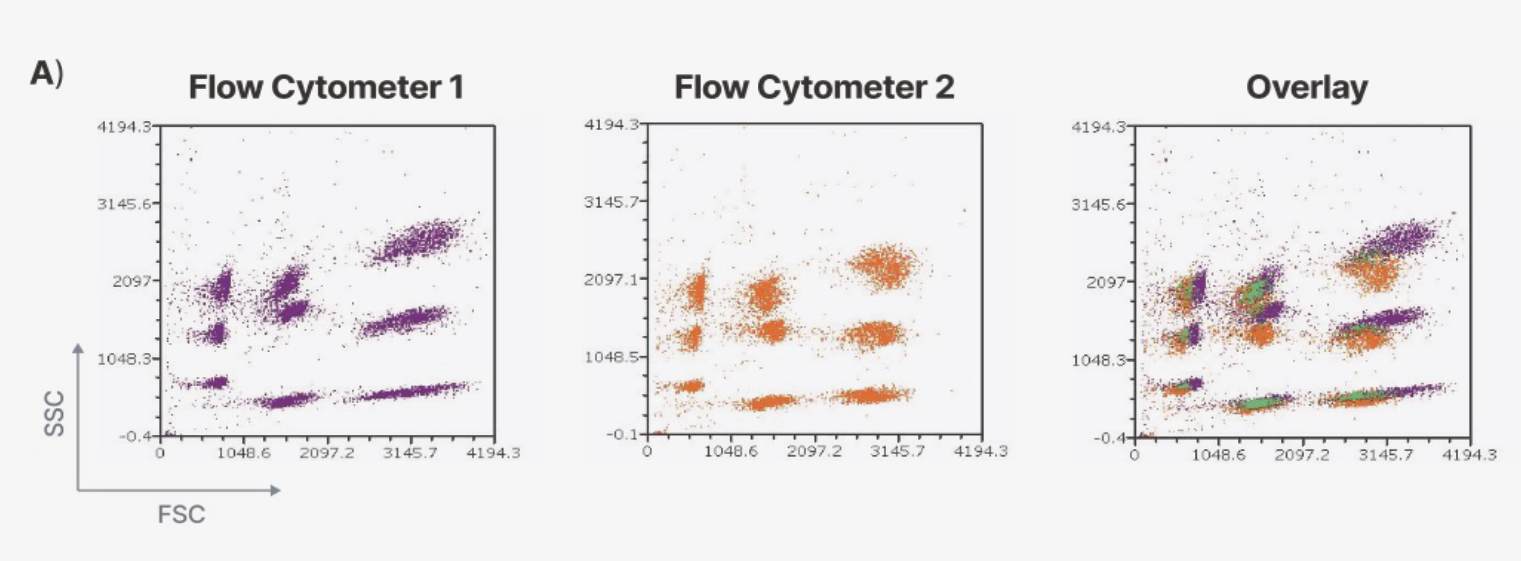
Because ScatterBridge particles are synthetic and manufactured to lot-stable specifications, any population shift observed between instruments cannot be attributed to sample-level biological variation. The particles serve as a pure instrument performance signal, allowing the operator to directly attribute population differences to instrument state and to make unambiguous equivalence determinations.
Outcomes
ScatterBridge controls confirmed that both instruments were performing equivalently within acceptable thresholds across all populations tested.
Because ScatterBridge particles are synthetic and lot-stable, population measurements isolate instrument performance from donor biology, giving this manufacturer an objective, transferable basis for cross-site instrument qualification that does not depend on sourcing equivalent biological material at each location.
ScatterBridge equivalence data can be included in technology transfer documentation as formal evidence of instrument alignment, without the logistical burden of shipping and re-qualifying donor-derived reference material site to site. This directly supports faster, more defensible technology transfer to new GMP manufacturing sites.
For a manufacturing organization building a distributed manufacturing network, that speed matters but the regulatory defensibility matters more. Instrument equivalence demonstrated with a synthetic, lot-stable reference isolates instrument performance from all other variables, producing the kind of unambiguous, auditable evidence that supports analytical comparability conclusions in BLA submissions, justifies platform additions in post-approval supplements, and withstands scrutiny during GMP inspections. It transforms instrument qualification from an internal operational checkpoint into a durable, transferable CMC asset.
Stay Updated
Subscribe to receive product updates, new resources, webinars, and application notes.
Get the full case study
Download the complete write-up, with methods, figures and references, to share with your team.
Download PDF