Reliable flow cytometry assays are essential for clinical trials, particularly when assessing response to novel targeted therapies. However, traditional assay controls—like standardized cell lines—often fall short. They don't always reflect the biophysical and immunophenotypical properties of actual patient samples, leading to gating challenges and QA headaches.
A recent study published in Cytometry Part B: Clinical Cytometry, titled "Evaluation of a multiple myeloma synthetic cell mimic as an assay control for flow cytometry," presents a promising alternative: custom synthetic cell mimics designed using Slingshot Biosciences’ TruCytes® platform.
Here are the key takeaways from the study and why this matters for clinical flow cytometry.
1. Overcoming the Limitations of Traditional Cell Lines (MM1.S)
In Multiple Myeloma (MM) clinical trials, the MM1.S cell line is routinely used as a control because it strongly expresses target antigens like BCMA and GPRC5D. However, MM1.S has major drawbacks:
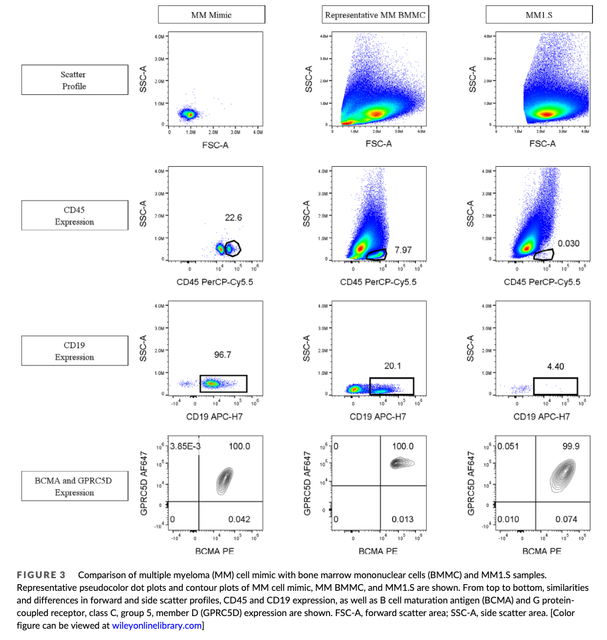
- It lacks critical lineage markers like CD45 and CD19, which are required for comprehensive identification of plasma cells and B cells.
- Its forward and side scatter (FSC/SSC) profiles differ significantly from real patient samples, requiring the use of separate gating strategies for controls versus clinical samples.
- New lots of cell lines require extensive time for thawing, expansion, aliquoting, cryopreservation, and qualification.
2. A Two-Population Synthetic Solution
To solve the above limitations, scientists engineered a synthetic MM cell mimic featuring two distinct populations mixed at a 75:25 ratio:
- Plasma Cell Mimic (75%): Engineered with CD45dim, CD138, CD38, CD56, PD-L1, GPRC5D, and BCMA.
- B Cell Mimic (25%): Engineered with CD45bright and CD19.
This dual-population design accurately mimics the scatter profile of lymphocytes and antigen density seen in three representative MM bone marrow mononuclear cells (BMMCs). Additionally, the two populations serve as reciprocal internal negative controls for one another.

3. High Precision Across Lab Variables
The mimics were then qualified following a fit-for-purpose analytical validation approach consistent with CLSI H62 (Clinical and Laboratory Standards Institute [CLSI], 2021) and recent method-validation recommendation for flow cytometry assays (Monaghan et al., 2025).
Table 2. Summary of qualification study design. CV, coefficient of variation; SD, standard deviation. Adapted from Lee et al., Cytometry Part B: Clinical Cytometry (2026), CC BY-NC 4.0.
| Assessment | Study design | Acceptance criteria |
|---|---|---|
| Intra-assay precision | Five replicate measurements within a single run | ≤20% CV |
| Inter-assay precision | Three independent runs on separate days | ≤20% CV |
| Inter-instrument precision | Same samples analyzed on three Cytek Aurora instruments | ≤20% CV |
| Inter-analyst precision | Independent preparation and acquisition by three different analysts | ≤20% CV |
| Closed-vial storage stability | Reverse accelerated aging at 37°C in triplicate with Arrhenius translation to −20°C (0–13 months) | ≤20% CV from Day 0 |
| Post-reconstitution stability | Reconstituted mimic stored at 4°C and tested on Days 0, 3, 5 and 7 | ≤20% change from Day 0 |
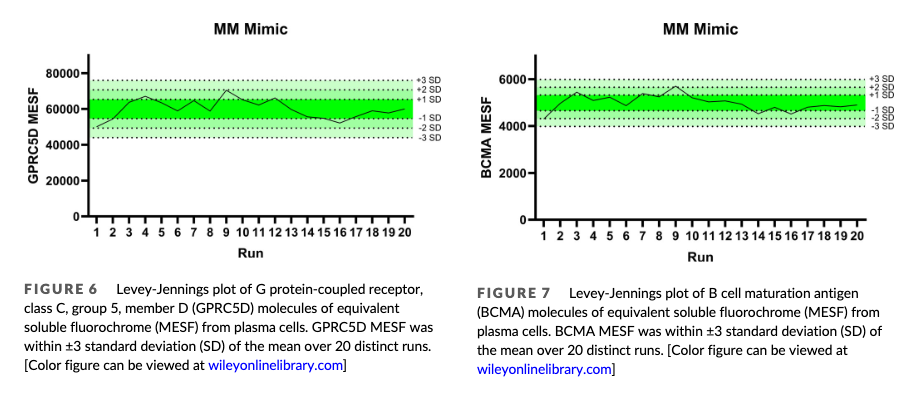
| Longitudinal performance | 20 independent runs over ~2 months | Within ±3 SD of the mean |
Across multiple testing angles, it delivered robust precision:
- Intra- & Inter-Assay Precision: %CV ≤20% across key target markers was achieved.
- Inter-Instrument & Inter-Analyst Reproducibility: Demonstrated consistent performance across different Cytek Aurora instruments and different laboratory operators.
- Site-to-site consistency: Stability testing performed at separate sites using Cytek Aurora instruments showed that the MM cell mimic successfully sustained performance within predefined acceptance criteria.
4. Exceptional Operational Stability & Convenience
Unlike traditional cell lines that require continuous, labor-intensive cell culture maintenance or liquid nitrogen storage, the synthetic MM mimics offer superior shelf-life and usability:
- Closed-Vial Storage: Stable for up to 13 months at -20°C (supported by accelerated aging models).
- Post-Reconstitution: Remains stable at 4°C for up to 7 days.
- Rapid Preparation: Ready to use within 5 minutes of reconstitution.
- Longitudinal assay performance: key parameters of GPRC5D-AF647 MESF and BCMA-PE MESF maintained consistent performance within ±3 SD of the mean across 20 independent runs over a 2-month period, demonstrating suitability for routine QC monitoring.

5. Highly Tunable for Future Panels
Because these mimics are synthetic hydrogel particles, their antigen density and marker profiles can be tailored. While the current formulation matched an existing 8-color MM clinical panel, future iterations can easily incorporate additional biomarkers (such as CD117, CD27, or CD81) or be tuned for antibody titrations and lot-to-lot reagent bridging.
The Bottom Line
Slingshot Bio’s TruCytes® cell mimics bridge the gap between traditional cell lines and primary patient samples, serving as improved and alternative assay controls. By combining representative scatter properties, complete lineage markers, long-term stability, and plug-and-play operational ease, they offer a reliable path forward for longitudinal assay performance monitoring, continuous quality assurance, and confident assay interpretation in clinical flow cytometry.
References
Lee DH, Liu M, Palla K, et al. Evaluation of a multiple myeloma synthetic cell mimic as an assay control for flow cytometry. Cytometry B Clin Cytom. 2026. doi:10.1002/cyto.b.70075
Stay Updated
Subscribe to receive product updates, new resources, webinars, and application notes.