- <9%CV across 11 independent lots at commercial scale
- 4 hoursto rapid IFNγ secretion, comparable to Raji cells
- 24 hoursof sustained cytokine release, outperforming Raji cells
- 3 runson independent days with consistent IFNγ secretion from one CAR-T lot
Abstract
Slingshot Biosciences has developed TruCytes™ Potency, a new class of lyophilized biomarker cell mimics that express specific target antigens (e.g. CD19, BCMA) to generate immune activation in co-culture with CAR-T cells. These precision-engineered cell mimics offer a reliable and efficient alternative to cell lines for delivering consistent pro-inflammatory cytokine release in CAR-T potency assays.
In IFNγ release assays, TruCytes demonstrated biologically relevant and reproducible T cell activation comparable to cell lines (Raji, Daudi, MM.1S) and superior to microbeads coated with target proteins. Additionally, TruCytes offered consistent readouts across multiple runs and customizable antigen expression to modulate CAR-T responses, addressing key regulatory needs for a potency assurance strategy. These results support the use of TruCytes Potency cell mimics as an effective, reliable, and versatile solution for optimizing functional cell therapy potency assays, with the potential to reduce the time and cost of therapy commercialization.
Introduction
According to 21 CFR 600.3, the U.S. Food and Drug Administration (FDA) defines potency for cell and gene therapies as “the specific ability or capacity of the product, as indicated by appropriate laboratory tests or by adequately controlled clinical data obtained through the administration of the product in the manner intended, to effect a given result” (21 CFR 600.3(s)).
In practice, this definition underscores the need for drug-specific assays capable of confirming therapeutic function throughout manufacturing and, most critically, at the lot release stage.
Key limitations of current cell therapy potency assays include the inherent variability of biological starting materials, absence of standardized reference controls, and the complex, often multi-modal mechanisms of action inherent to CAR constructs. These challenges have prompted regulatory agencies to shift expectations. In its December 2023 draft guidance, the FDA emphasized the need for a potency assurance strategy, described as a collection of orthogonal, fit-for-purpose assays that collectively demonstrate product consistency, quality, and intended biological activity, rather than relying on a singular potency assay.
A comprehensive potency assurance strategy may incorporate viability assays, immunophenotyping, functional assays such as cytotoxicity and cytokine secretion to demonstrate MoA, and dose-response analyses to correlate biological activity with product concentration. Together, these approaches aim to establish a quantitative, biologically relevant link between product characteristics and therapeutic efficacy, essential for consistent clinical outcomes.
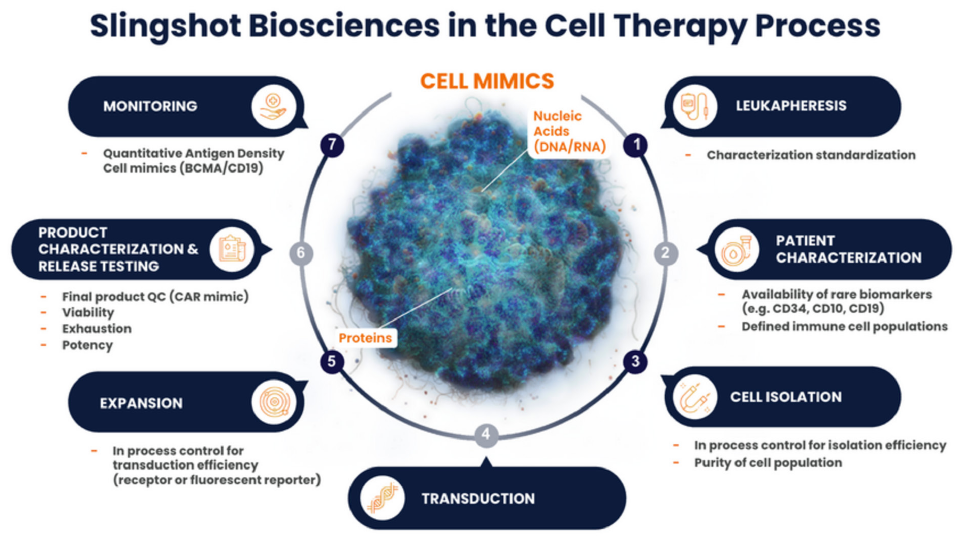
To help address the critical gap in standardized reference materials, Slingshot Biosciences has developed precision-engineered cell mimics designed to support quality control across all stages of cell therapy development (Fig. 1). TruCytes are customizable and reproducibly manufactured to express relevant surface antigens with controlled antigen density, making them ideal surrogates for biological controls that are prone to variability. Through robust manufacturing and precision engineering, TruCytes expressing key immune cell markers have been consistently produced at commercial scale with CVs below 9% across 11 independent lots (Table 1). This demonstrated scalability of TruCytes manufacturing ensures the platform can support cell therapy assay development through full commercialization. This application note highlights the use of CD19- and BCMA- expressing TruCytes in CAR-T cell cytokine release assays as reliable, antigen-specific targets for functional CAR-T potency assessment.
| Population Type | Lot 1 | Lot 2 | Lot 3 | Lot 4 | Lot 5 | Lot 6 | Lot 7 | Lot 8 | Lot 9 | Lot 10 | Lot 11 | CV% |
|---|---|---|---|---|---|---|---|---|---|---|---|---|
| Grans CD45+ | 5 | 4 | 5.8 | 4.8 | 4.7 | 4.8 | 4.5 | 5 | 5.3 | 5 | 4.8 | 8.81% |
| Monos CD45+ | 15.5 | 15.4 | 15.5 | 14.2 | 14.7 | 14.4 | 14.6 | 14 | 15.8 | 13.8 | 14.1 | 4.57% |
| Lymphs CD45+ | 78.7 | 79.1 | 77 | 80 | 79.6 | 80 | 79 | 80.3 | 77.3 | 79.8 | 79.7 | 1.32% |
| T cells CD3+ | 77.3 | 76.2 | 69.6 | 74.8 | 73.6 | 74.3 | 72.9 | 74.6 | 74 | 72.5 | 73.4 | 2.58% |
| B cells CD19+ | 12.5 | 13.7 | 16.5 | 14.5 | 15.7 | 14.8 | 16.2 | 14.7 | 15.1 | 16 | 14.4 | 7.51% |
| T Helper CD4+ | 67 | 65.4 | 65.3 | 68.2 | 66.1 | 66.5 | 65.4 | 66 | 66.2 | 66 | 67.9 | 1.40% |
| T Cytotoxic CD8+ | 33 | 34.6 | 34.6 | 31.7 | 33.8 | 33.5 | 34.6 | 33.8 | 33.8 | 33.9 | 32.1 | 2.76% |
| NK cells CD16+CD56+ | 94.2 | 99.8 | 98.8 | 99.8 | 99.9 | 98.8 | 99 | 99.7 | 98.8 | 98.8 | 98.6 | 1.53% |
| Classical Monos CD14+ | 93.6 | 99.8 | 98.6 | 99.3 | 98.6 | 94.1 | 98.4 | 97.7 | 99.5 | 99.3 | 99.5 | 2.10% |
Table 1: TruCytes Lymphocytes Subsets cell mimics composition across 11 lots from scale-up to full manufacturing and CV% across 11 lots demonstrate high reproducibility of production lots at full commercial scale.
Methods
CD19 Potency Assay Conditions
TruCytes Potency biomarker cell mimics expressing CD19, with and without enhancer molecules, were developed and prepared in a lyophilized format. The effectors assessed were anti-CD19 CAR-T cells or untransduced T cells from the same donor, purchased from BPS Biosciences.
For inter-day comparisons, multiple vials of CAR-T from the same lot were purchased from BPS and stored in LN2 until use. CD19 coated microbeads as well as Raji and Daudi cells were run in parallel. The co-culture assay was performed at a 1:5 E:T ratio (1 x10⁵ T Cells : 5 x10⁵ TruCytes or Cells) in a 96 well non-treated clear, sterile, flat bottom plate. Culture media consisting of 10% FBS + RPMI + GlutaMax + 1% PS (no added cytokines) was prepared fresh on the day of the co-culture.
Technical duplicates were performed on replicate plates for each time point. Supernatant (50 µl) was harvested at 4, 6, 18 and/or 24 hours. Supernatants were stored at -20°C until quantified for IFNγ using an ELISA kit or Cytometric Bead Array kit from Becton Dickinson.
BCMA Potency Assay Conditions
TruCytes Potency biomarker cell mimics expressing BCMA, with and without enhancer molecules, were developed and prepared in a lyophilized format. Anti-BCMA CAR-T cells from BPS Biosciences served as the effector cells. For inter-day comparisons, multiple vials of CAR-T from the same lot were purchased and stored in LN2 until use. BCMA coated microbeads as well as MM.1S and H929 cells were run in parallel. The co-culture assay was performed at a 1:5 E:T ratio (1 x10⁵ T Cells : 5 x10⁵ TruCytes or target cells) in a 96 well non-treated clear, sterile, flat bottom plate. Culture media consisting of 10% FBS + RPMI + GlutaMax + 1% PS (no added cytokines) was prepared fresh on the day of the co-culture.
Technical duplicates were performed on replicate plates for each time point. Supernatant (50 µl) was harvested at 4, 6, 18 and/or 24 hours. Supernatants were stored at -20°C until quantified for IFNγ using an ELISA kit or for IFNγ, TNFα, and IL-2 with a Th1/2 CBA kit from Becton Dickinson on a Cytek Aurora cytometer.
Results & Discussion
TruCytes Potency Cell Mimics Enable Rapid, Sustained, and Specific CAR-T Activation
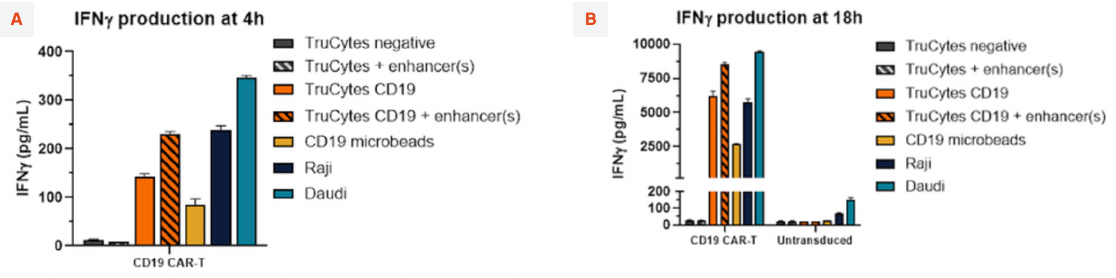
TruCytes Potency cell mimics expressing CD19 and enhancer molecules induced rapid IFNγ secretion within 4 hours of co-culture with CAR-T cells, comparable to responses observed with Raji cells (Fig. 2A). This IFNγ response was sustained up to 18 hours and outperformed both Raji cells and CD19 coated microbeads at the later time point, indicating the ability of TruCytes to support sensitive detection of CAR-T functional activity across a broad assay window. (Fig. 2B). Moreover, TruCytes demonstrated reduced nonspecific activation compared to tumor cell lines, enabling more specific assessment of antigen-driven responses and improving assay precision (Fig. 2B).
TruCytes Potency Cell Mimics Drive Reproducible Functional Responses Across Experiments
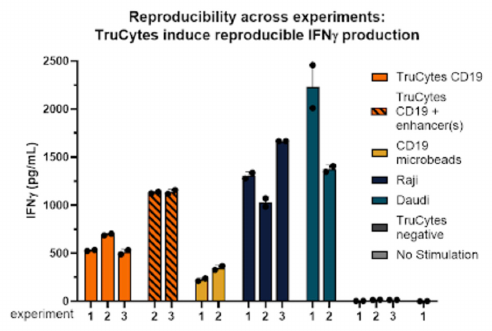
To further evaluate reproducibility, co-culture assays were performed on three independent days using the same CAR-T cell lot. TruCytes, with and without enhancer molecules, demonstrated consistent IFNγ secretion across experiments, avoiding the variability observed when using different passages of tumor cell lines (Fig. 3). This reproducibility, driven by precision manufacturing, supports the use of TruCytes as standardized potency reagents, facilitating more robust lot release testing and potentially reducing manufacturing turnaround times from apheresis to infusion.
This observed reproducible performance across experiments also supports regulatory expectations for assay consistency in cell therapy manufacturing.
Antigen Density Tuning of TruCytes Potency Cell Mimics Modulates CAR-T Activation Strength
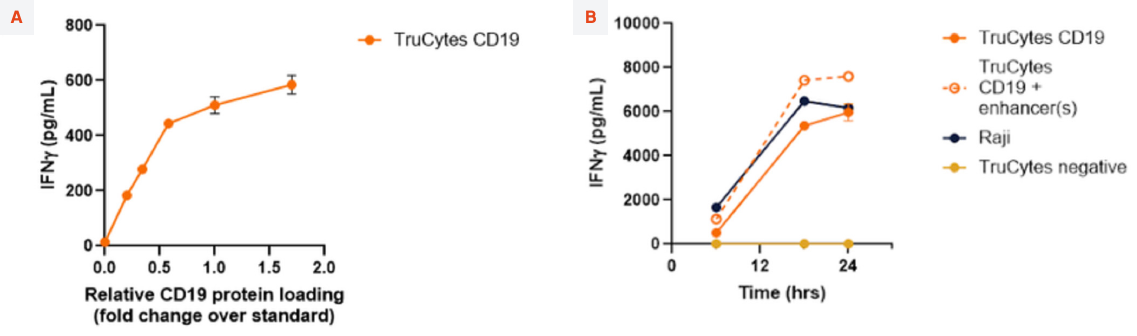
Titration of CD19 on TruCytes showed a dose-dependent IFNγ response, confirming that antigen density can be adjusted to modulate activation strength (Fig. 4A). Sustained cytokine release through 24 hours was observed, with TruCytes CD19 + enhancer(s) outperforming Raji cells in IFNγ production (Fig. 4B). The ability to modulate CAR-T activation by tuning CD19 density on TruCytes enables customizable assay sensitivity, supporting the development of potency assays that better reflect therapeutic thresholds and functional performance across different CAR designs. These optimizations could help maintain alignment between potency assay performance and evolving manufacturing processes.
Platform Versatility Demonstrated with BCMA-Expressing TruCytes Potency Cell Mimics
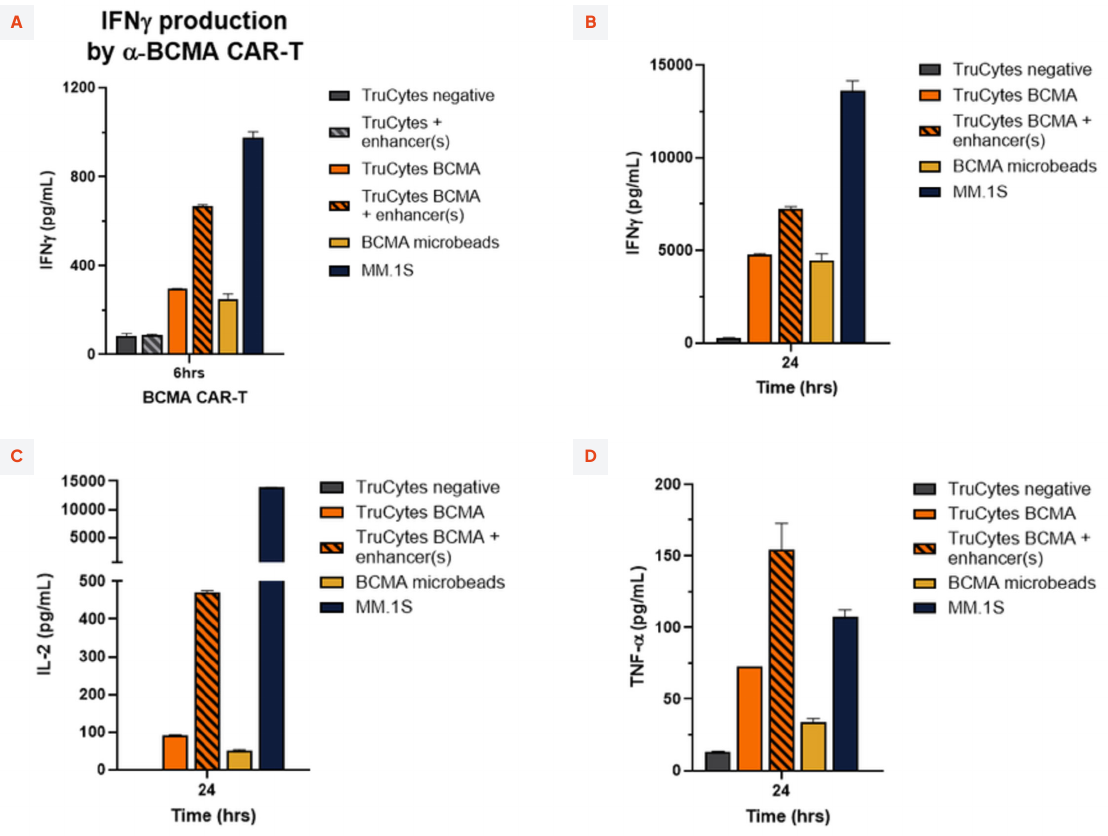
To demonstrate the versatility of the TruCytes platform, BCMA-expressing potency mimics were generated and evaluated. Similar to our results with TruCytes Potency CD19 cell mimics and CD19-specific CAR-T, TruCytes Potency BCMA cell mimics induced BCMA-specific CAR-T cell activation comparable to CD19 constructs, with enhancer molecules increasing activation at the 6-hour time point and sustained through 24-hour time point (Fig. 5A,B). In addition to IFNγ, TruCytes Potency BCMA cell mimics stimulated secretion of IL-2 and TNF-α at 24 hours (Fig. 5C,D), demonstrating the ability to capture a broader functional cytokine profile critical for comprehensive potency assessment across diverse CAR targets.
Conclusion
These results demonstrate that TruCytes Potency cell mimics are an effective, reliable, and versatile solution for optimizing functional CAR-T potency assays. Their ability to generate early and sustained cytokine responses, reduce nonspecific activation compared to tumor cell lines, and modulate activation strength through antigen density tuning makes them ideally suited for controlled, reproducible assessments of CAR-T function.
Furthermore, the demonstrated flexibility to present both CD19- and BCMA-expressing cell mimics, along with the induction of multiple pro-inflammatory cytokines, underscores the platform’s versatility across diverse CAR targets. TruCytes have also shown reproducible biomarker expression at commercial scale across multiple lots, demonstrating that the platform is not only effective in early development but scalable for full clinical and commercial deployment.
Together, these attributes have the potential to improve potency assay sensitivity and specificity, providing a robust quality control platform for confirming therapeutic function throughout manufacturing—and, most critically, at the lot release stage.
Key Takeaways
- TruCytes Potency cell mimics deliver early, sustained, and reproducible cytokine responses in CAR-T co-culture assays—comparable or superior to tumor cell lines.
- Antigen density tuning enables assay sensitivity optimization, improving result relevance and reproducibility across runs and sites.
- Reduced nonspecific activation compared to tumor cell lines improves assay specificity and minimizes background signal.
- Replacing cell line-derived target cells with TruCytes Potency cell mimics eliminates the variability, maintenance, and quality assurance burdens of using biological materials.
- Demonstrated performance with CD19- and BCMA-expressing TruCytes suggests likely success of developing functional targets for other cell therapies like CAR-NK and CAR-macrophage as well.
Featured product
StimCytes™ CD19
Interested in Designing a Potency Assay Target? Contact our team to discuss a custom TruCytes Potency solution tailored to support your cell therapy development, manufacturing, and regulatory goals.
slingshotbio.com/products/stimcytes-cd19SL-00035
 View all product info
For Research Use Only. Not for use in diagnostic or therapeutic procedures.
Stay Updated
Subscribe to receive product updates, new resources, webinars, and application notes.
Get the full application note
Download the complete note as a PDF, with the figures and reference, to share with your team.
Download PDF