- 0.1–5.7%lot-to-lot CV for TBNK Mimics, vs 1.6–36.6% for PBMCs
- <4%intra-lot CV across users, instruments, and time intervals
- 18 monthsclosed-vial stability at –20°C
- 11 lotswithin 1.3–8.8% CV from scale up to manufacturing
Introduction
These assays play a critical role in monitoring patient responses, evaluating therapeutic efficacy, and assessing potential safety concerns in preclinical research and clinical applications. However, their accuracy and reproducibility rely heavily on the quality and consistency of the control materials used.
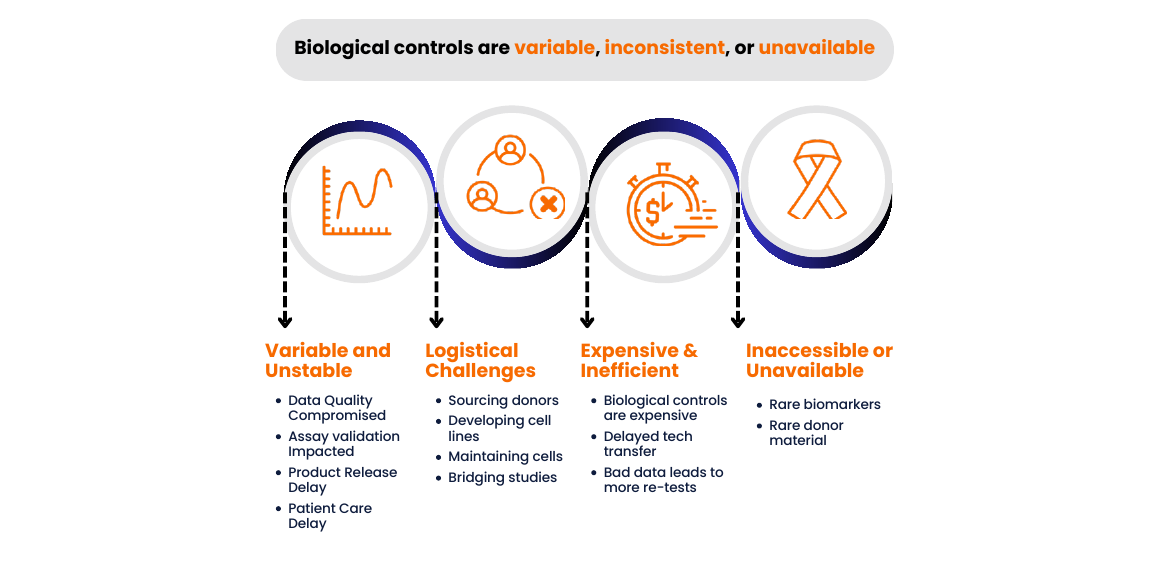
Traditionally, donor-derived peripheral blood mononuclear cells (PBMCs) controls have been used for these assays, but they present significant challenges. These include the inherent biological variability between donors, lot-to-lot inconsistencies, limited stability, and complex sourcing logistics—all of which can compromise assay performance and delay development timelines. The logistical and ethical complexities of acquiring and maintaining human biological materials further complicate efforts to standardize and scale immunophenotyping workflows (Figure 1).
To address these limitations, Slingshot Biosciences has developed TBNK Mimic™ Controls, engineered to replicate the optical and biochemical properties of PBMCs. By mimicking key immune cell subsets, such as T cells (CD3, CD4, CD8), B cells (CD19), NK cells (CD16, CD56), and monocytes (CD14), TBNK Mimics provide a scalable, reproducible, and workflow-compatible alternative to donor-derived PBMC controls.
The proprietary technology behind TBNK Mimics enables fine-tuning of both scatter coordinates (FSC and SSC) and biomarker expression, allowing the synthetic particles to closely resemble the phenotype of primary immune cells in flow cytometry assays. Unlike PBMCs, which can vary in biomarker expression and population frequencies across donors, TBNK Mimics are consistently manufactured to precise specifications to ensure enhanced reproducibility across assays, operators, sites, and instruments.
This application note presents data comparing TBNK Mimics to traditional PBMC-based controls, comparing lot-to-lot consistency, intra-lot reproducibility, extended stability, and compatibility with standard immunophenotyping assay protocols.
Methods
Study Design and Controls
This study evaluated the performance of TBNK Mimics compared to traditional lyophilized and cryopreserved PBMC controls.
TBNK Mimics are polymer-based lyophilized particle engineered to replicate the optical and biochemical properties of PBMCs or leukopak-derived controls in terms of scatter, biomarker expression levels, and immune cell subset population frequencies. The populations included in the TBNK Mimic kit are T cells (CD3 and CD4/CD8), NK cells (CD16 and CD56), B cells (CD19), and Monocytes (CD14). All experiments were performed on a Cytek® Aurora CS flow cytometer.
Lot-to-Lot Consistency
The lot-to-lot consistency of the TBNK Mimics was assessed by comparing two lots of TBNK Mimics with two lots of lyophilized and cryopreserved PBMC controls. Each lot was analyzed for variability in fluorescence intensity and population distribution, and the coefficient of variation (CV) was calculated to quantify variability. Intra-lot consistency was assessed by analyzing replicate samples run on the same instrument across different days and users.
Fixation Buffer Compatibility
The compatibility of TBNK Mimic was evaluated with three commercially available fixation buffers: eBioscience™ IC Fixation Buffer, BioLegend® Fixation Buffer, and BD CytoFix®. After fixation, cells and mimics were stained with antibodies targeting immune cell markers (CD3, CD4, CD8, CD19, CD14, CD16, and CD56) to confirm the cell mimics retained their immunofluorescence capabilities. The ability of the fluorescent antibodies to detect their cognate antigens was evaluated based on signal intensity and antigen binding.
RBC Lysis Protocol Compatibility
To assess the compatibility of TBNK Mimics with red blood cell (RBC) lysis protocols, two different RBC lysis methods were tested using a 1X RBC Lysis Buffer. Lyse/wash and lyse/no wash protocols were compared to a no-lysis control.
Antibody Clones and Fluorescent Labeling
TBNK Mimics were stained with antibodies targeting CD45, CD3, CD4, CD8, CD19, CD14, CD16, and CD56. Each marker was evaluated using three different antibody clones to assess compatibility and effectiveness in differentiating positive and negative populations (Table 1).
Data Acquisition and Analysis
Flow cytometry data were acquired using the Cytek® Aurora CS system. For each experiment, samples were run in triplicate, and data were collected for each immune cell subset of interest. Gating strategies based on forward scatter (FSC), side scatter (SSC), and fluorescence parameters were used to identify the immune cell subset populations. Data analysis was performed by calculating the CV for each control material to assess reproducibility and variability across lots and conditions.
Results & Discussion
Antibody Clone Compatibility of TBNK Mimics
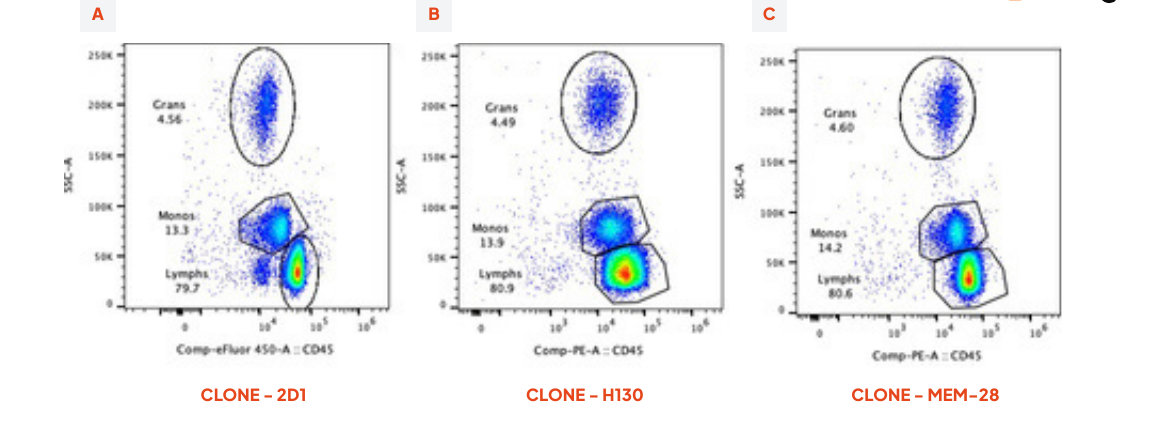
The TBNK Mimics were stained with commonly used antibody clones for each marker (Table 1). Each clone showed excellent separation between the positive and negative populations except for OKT3 and HIT3a for CD3. Based on these results, we recommend using the SK7 or UCHT1 clones for CD3 staining with TBNK Mimics to ensure optimal performance in immunophenotyping assays. Figure 2 shows TBNK Mimics stained with CD45 clones 2D1, HI30 and MEM-28.
| Marker | Clone 1 | Clone 2 | Clone 3 |
|---|---|---|---|
| CD45 | 2D1 | HI30 | MEM-28 |
| CD3 | SK7 | UCHT1 | OKT3/HIT3a |
| CD8 | SK1 | HIT8a | RPA-T8 |
| CD4 | SK3 | OKT4 | RPA-T4 |
| CD16 | B73.1 | CB16 | 3G8 |
| CD19 | SJ25C1 | HIB19 | 4G7 |
| CD56 | NCAM 16.2 | MEM-188 | MY-31 |
| CD14 | M5E2 | 61D3 | HCD14 |
Table 1: Antibody clone compatibility of Slingshot Biosciences TBNK Mimic™. Note that clones 2 and 3 for all markers were tested using PE.
Lot-to-Lot Reproducibility
TBNK Mimics can be manufactured with high reproducibility at full commercial scale. Eleven lots demonstrated %CV of 1.3% to 8.8% across all populations from scale up to manufacturing (Table 2).
| Population Type | Lot 1 | Lot 2 | Lot 3 | Lot 4 | Lot 5 | Lot 6 | Lot 7 | Lot 8 | Lot 9 | Lot 10 | Lot 11 | CV% |
|---|---|---|---|---|---|---|---|---|---|---|---|---|
| Grans CD45+ | 5 | 4 | 5.8 | 4.8 | 4.7 | 4.8 | 4.5 | 5 | 5.3 | 5 | 4.8 | 8.81% |
| Monos CD45+ | 15.5 | 15.4 | 15.5 | 14.2 | 14.7 | 14.4 | 14.6 | 14 | 15.8 | 13.8 | 14.1 | 4.57% |
| Lymphs CD45+ | 78.7 | 79.1 | 77 | 80 | 79.6 | 80 | 79 | 80.3 | 77.3 | 79.8 | 79.7 | 1.32% |
| T cells CD3+ | 77.3 | 76.2 | 69.6 | 74.8 | 73.6 | 74.3 | 72.9 | 74.6 | 74 | 72.5 | 73.4 | 2.58% |
| B cells CD19+ | 12.5 | 13.7 | 16.5 | 14.5 | 15.7 | 14.8 | 16.2 | 14.7 | 15.1 | 16 | 14.4 | 7.51% |
| T Helper CD4+ | 67 | 65.4 | 65.3 | 68.2 | 66.1 | 66.5 | 65.4 | 66 | 66.2 | 66 | 67.9 | 1.40% |
| T Cytotoxic CD8+ | 33 | 34.6 | 34.6 | 31.7 | 33.8 | 33.5 | 34.6 | 38 | 33.8 | 33.9 | 32.1 | 2.76% |
| NK cells CD16+CD56+ | 94.2 | 99.8 | 98.6 | 99.8 | 99.9 | 99.8 | 99 | 99.7 | 98.8 | 98.8 | 98.6 | 1.53% |
| Classical Monos CD14+ | 93.6 | 99.8 | 98.6 | 99.3 | 98.6 | 94.1 | 98.4 | 97.7 | 99.5 | 99.3 | 99.5 | 2.10% |
Table 2: TBNK Mimics demonstrates high lot-to-lot reproducibility from scale up to manufacturing. %CV was calculated for the percent population across 11 lots. Lymphs = Lymphocytes. Monos = Monocytes. Grans = Granulocytes. NK = Natural Killer.
The lot-to-lot consistency of TBNK Mimic Particles was further evaluated by comparing two lots of TruCytes™ with two lots of lyophilized and cryopreserved PBMC controls. The percent CV (coefficient of variation) for TruCytes™ ranged from 0.1% to 5.7%, compared to PBMCs, where CVs ranged from 1.6% to 36.6% (Table 3).
TBNK Mimic lots showed less variation in population percentages compared to PBMC-based controls, demonstrating their lot-to-lot consistency and suitability as more reliable and reproducible controls for flow cytometry assays.
| Population | Lyophilized PBMC Lot-to-lot %CV | Cryopreserved PBMC Lot-to-lot %CV | TBNK Mimic Lot-to-lot %CV |
|---|---|---|---|
| Grans CD45+ | N/A | N/A | 2.5 |
| Monos CD45+ | 13.9 | 34.5 | 4.4 |
| Lymphs CD45+ | 10.2 | 15.2 | 0.6 |
| T Cells CD3+ | 12.1 | 1.2 | 1.3 |
| B Cells CD19+ | 36.6 | 19.8 | 5.7 |
| NK Cells CD3-/CD19- | 29.1 | 8.8 | 1.6 |
| T Helper CD4+ | 15.2 | 17.4 | 1.2 |
| T Cytotoxic CD8+ | 18.7 | 18.7 | 2.3 |
| NK Cells CD16+/CD56+ | 17.7 | 3.3 | 0.3 |
| Classical Monos CD14+ | 1.6 | 8.3 | 0.1 |
Table 3: TBNK Mimics demonstrates less variation between lots than PBMCs. % CV was calculated for the percent population as evaluated on the Cytek Aurora across two lots of each different control material. Orange denotes high variability whereas blue indicates low variability. Lymphs = Lymphocytes. Monos = Monocytes. Grans = Granulocytes. NK = Natural Killer.
Intra-Lot Sample-to-Sample Consistency
The intra-lot consistency of TBNK Mimics was assessed across different users, instruments, and time intervals. The % CV across three replicate samples from the same lot ranged from 0.1% to 3.8%. When tested on the same instrument by the same operator on two different days, the % CVs were 0.3% to 3.8%. Analysis of the same sample by a single operator on two different instruments (Cytek Northern lights and Cytek Aurora) on the same day produced % CVs of 0.2% to 3.9%, while different operators assessing the same sample on the same instrument and day showed % CVs between 0.3% and 3.3% (Table 4).
Overall, the high intra-lot consistency (within 4% CV) demonstrates that TBNK Mimics can generate reliable immunophenotyping results with minimal variability.
| Population | %CV, Same Instrument, Same Operator, Same Day | %CV, Same Instrument, Same Operator, Separate Days | %CV, Separate Instruments, Same Operator, Same Day | %CV, Same Instrument, Different Operators, Same Day |
|---|---|---|---|---|
| Grans CD45+ | 3.8 | 3.8 | 3.9 | 3.3 |
| Monos CD45+ | 2.6 | 2.3 | 2.8 | 1.4 |
| Lymphs CD45+ | 0.5 | 0.4 | 1.3 | 0.7 |
| T Cells CD3+ | 0.2 | 0.4 | 0.2 | 0.3 |
| B Cells CD19+ | 1.8 | 1.2 | 0.7 | 0.5 |
| NK Cells CD3-/CD19- | 1.2 | 2.1 | 1.6 | 1.7 |
| T Helper CD4+ | 0.3 | 0.3 | 0.4 | 0.3 |
| T Cytotoxic CD8+ | 0.6 | 0.5 | 0.7 | 0.6 |
| NK Cells CD16+/CD56+ | 0.3 | 0.4 | 0.6 | 0.2 |
| Classical Monos CD14+ | 0.1 | 0.2 | 0.2 | 0.2 |
Table 4: TBNK Mimics shows intra-lot consistency. %CV was calculated for the percent population within the same lot of product to evaluate consistency between various users, instruments, and time intervals. Lymphs = Lymphocytes. Monos = Monocytes. Grans = Granulocytes. NK = Natural Killer.
Stability Analysis
We assessed the stability of TBNK Mimics using an accelerated stability study based on the Arrhenius equation (Table 5). Our results demonstrate that these controls remain stable for up to 18 months in their lyophilized format when stored at -20°C. This shelf life is comparable to cryopreserved PBMCs, which can be stored long-term under ultra-low temperatures, but it significantly exceeds the stability of fresh PBMCs, which are typically viable for only 24–48 hours post-isolation. Moreover, storage at -20°C eliminates the need for liquid nitrogen, which is required to maintain the viability and reproducibility of frozen PBMCs, offering a more convenient solution for long-term storage.
| Population Type | Day 0 (0 months) Avg | Day 7 (6 months) Avg | Day 13 (12 months) Avg | Day 20 (18 months) Avg | Up to 18 months %CV |
|---|---|---|---|---|---|
| Grans CD45+ | 4.67 | 4.73 | 4.92 | 4.77 | 1.97% |
| Monos CD45+ | 14.64 | 14.43 | 14.84 | 14.76 | 1.05% |
| Lymphs CD45+ | 79.92 | 80.05 | 79.43 | 79.66 | 0.30% |
| T Cells CD3+ | 74.52 | 74.82 | 74.66 | 74.58 | 0.15% |
| B Cells CD19+ | 14.54 | 14.32 | 14.36 | 14.53 | 0.67% |
| NK Cells CD3-CD19- | 10.92 | 10.84 | 10.97 | 10.89 | 0.42% |
| T Helper CD4+ | 68.02 | 67.84 | 68.13 | 67.86 | 0.18% |
| T Cytotoxic CD8+ | 31.97 | 32.15 | 31.85 | 32.13 | 0.39% |
| NK Cells CD16+CD56+ | 99.95 | 99.91 | 99.93 | 99.91 | 0.02% |
| Classical Monos CD14+ | 99.96 | 99.97 | 99.95 | 99.96 | 0.01% |
Table 5: Accelerated stability testing of TBNK Mimics was performed in triplicate for each time point using the Arrhenius equation. TBNK Mimics were found to be stable for up to 18 months (<2 %CV) in the lyophilized form when stored at -20°C. Lymphs = Lymphocytes. Monos = Monocytes. Grans = Granulocytes. NK = Natural Killer.
Fixation Buffer Compatibility
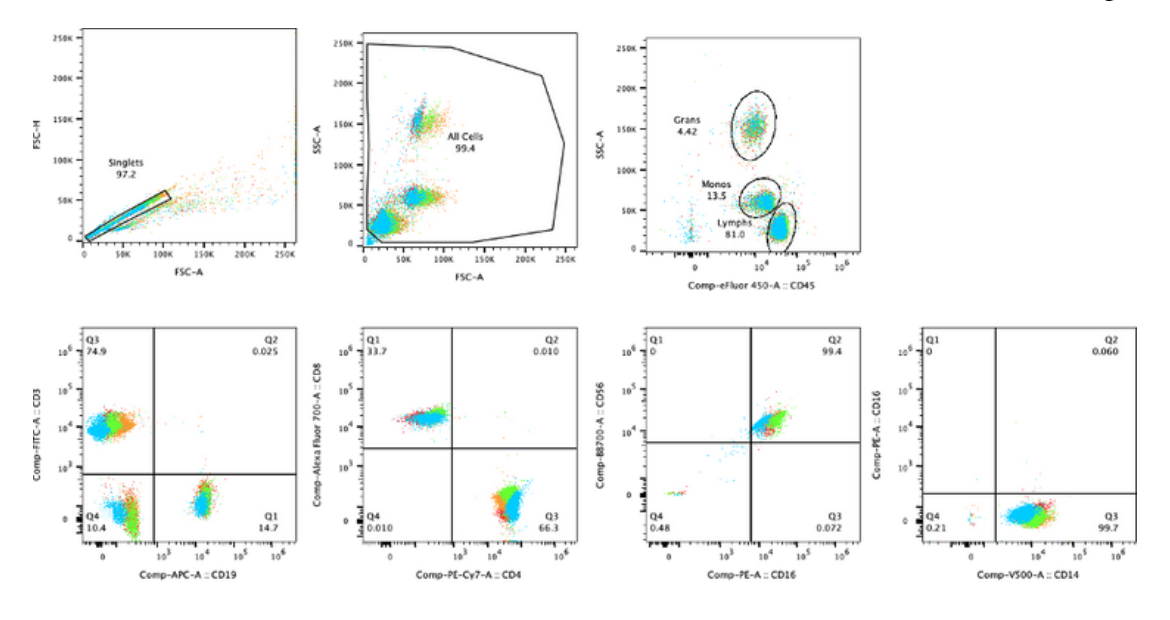
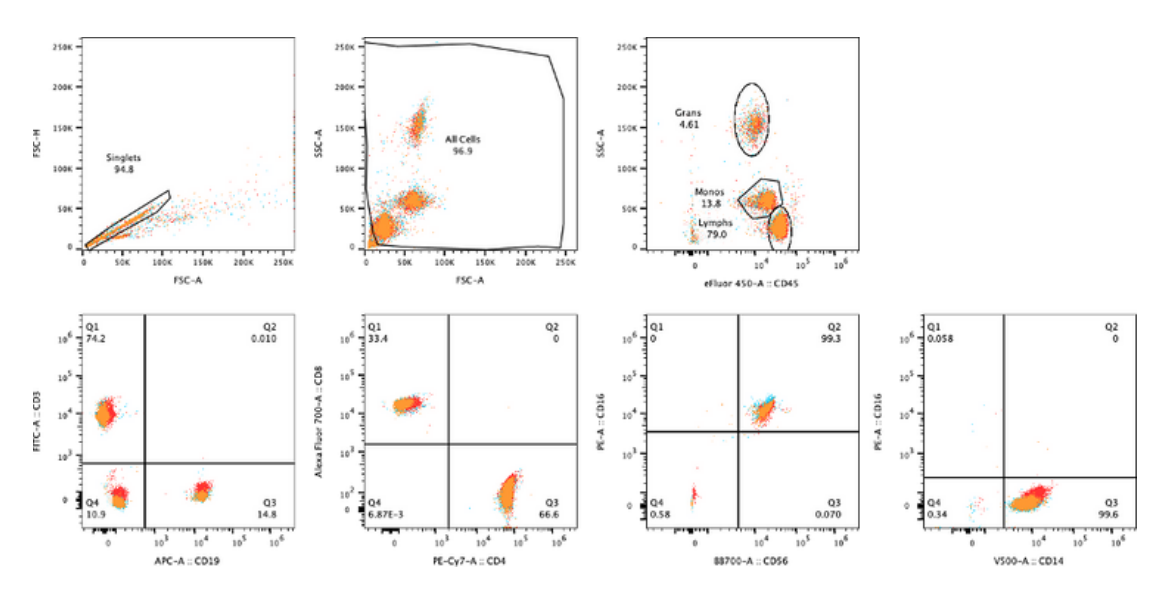
Three commercially available fixation buffers (eBioscience™ IC Fixation Buffer, BioLegend® Fixation Buffer, and BD CytoFix™) were used to evaluate the compatibility with TBNK Mimics for immunofluorescent staining combined with common fixation methods. Following fixation, TBNK Mimics were labeled for immune cell markers CD3, CD4, CD8, CD19, CD14, CD16, CD56, and CD45 (Figure 3) to confirm antigen binding using primary fluorophore-conjugated antibodies.
TBNK Mimics are compatible with commonly used antibodies and fixation buffers, allowing seamless integration into existing immunophenotyping workflows without the need for adaptation.
RBC Lysis Protocol Compatibility
Red blood cell (RBC) lysis is a standard step in immunophenotyping assays to eliminate contaminating RBCs while preserving lymphocyte integrity. Lyse/wash and lyse/no-wash protocols were compared to a no-lysis control using TBNK Mimics to evaluate their impact on antigen binding and assay performance.
TBNK Mimics demonstrates consistent performance in both lyse/wash and lyse/no-wash RBC lysis protocols, with no significant differences in immune cell subset separation or antigen binding (Figure 4).
This provides flexibility in immunophenotyping assay design, allowing researchers to choose the RBC lysis protocol that best suits their workflow without compromising the quality or reproducibility of results.
Conclusion
TBNK Mimics provides a robust, reproducible, and ready-to-use alternative to PBMC-derived controls for flow cytometry-based immunophenotyping. This evaluation demonstrates that these controls deliver:
- Improved lot-to-lot consistency compared to PBMC-based controls, with TBNK Mimic CVs ranging from 0.1% to 5.7% versus 1.6% - 36.6% CVs for PBMCs
- High intra-lot reproducibility, with CVs below 4% across users, instruments, and time intervals
- Closed-vial stability of 18 months at –20°C, matching or exceeding cryopreserved PBMCs and significantly outperforming fresh PBMCs
- Broad compatibility with common antibodies, fixation buffers, and RBC lysis protocols
- Consistency at scale during manufacturing with a %CV range of 1.3% to 8.8% across all populations within 11 lots
Unlike PBMCs, which suffer from biological variability, degradation, and complex logistics and handling requirements, TBNK Mimics are engineered to deliver consistent marker expression and immune cell subset distributions across lots. These attributes—combined with long-term stability, scalable manufacturing, and broad workflow compatibility—make TBNK Mimics better suited for research workflows, clinical trial assays, manufacturing processes, and quality systems requiring reliable, standardized controls.
By minimizing control-related variability, TBNK Mimics improve data integrity, accelerate panel development, and support cross-lab reproducibility—streamlining both early-stage discovery and late-stage validation.
With flow cytometry increasingly integrated into clinical, manufacturing, and regulated environments, the need for consistent, high-quality assay controls is more critical than ever. Engineered controls offer a better way forward: a reliable, reproducible, and scalable control that empowers scientists to move faster and with greater confidence.
From assay development to validation and regulatory submission, TBNK Mimics help bridge the gap between innovation and implementation—enabling more efficient and reliable delivery of advanced therapies and diagnostics to the patients who need them most.
Featured product
TBNK Mimic™
Streamline your immunophenotyping workflows with TBNK Mimics—reliable, ready-to-use, and built for consistent, reproducible results.
slingshotbio.com/products/tbnk-mimicSSB-31-A
 View all product info
For Research Use Only. Not for use in diagnostic or therapeutic procedures.
Stay Updated
Subscribe to receive product updates, new resources, webinars, and application notes.
Get the full application note
Download the complete note as a PDF, with the figures and reference, to share with your team.
Download PDF