As of July 2026, ClinicalTrials.gov lists more than 2,500 registered CAR-T and other chimeric antigen receptor trials, with roughly 970 actively recruiting and more than 1,100 registered since the start of 2024 alone. This rapid expansion underscores how quickly the field is advancing and how much pressure development and manufacturing teams face to reduce analytical risk, control costs and delays, and maintain alignment with evolving regulatory expectations.
To navigate this landscape, teams look to FDA guidance for practical direction on validating complex assays, demonstrating product consistency, and structuring submissions that withstand regulatory scrutiny. The January 2024 guidance document Considerations for the Development of Chimeric Antigen Receptor (CAR) T Cell Products and the 2015 guidance Analytical Procedures and Methods Validation for Drugs and Biologics together outline the principles manufacturers must incorporate into their analytical and manufacturing strategies. Complementing these FDA documents, the Clinical Laboratory Standards Institute's (CLSI) Guideline H62 Validation of Assays Performed by Flow Cytometry provides the first consensus standard for validating cell-based assays performed by flow cytometry, helping the field address analytical challenges as advanced cytometry techniques become integral to modern manufacturing workflows.
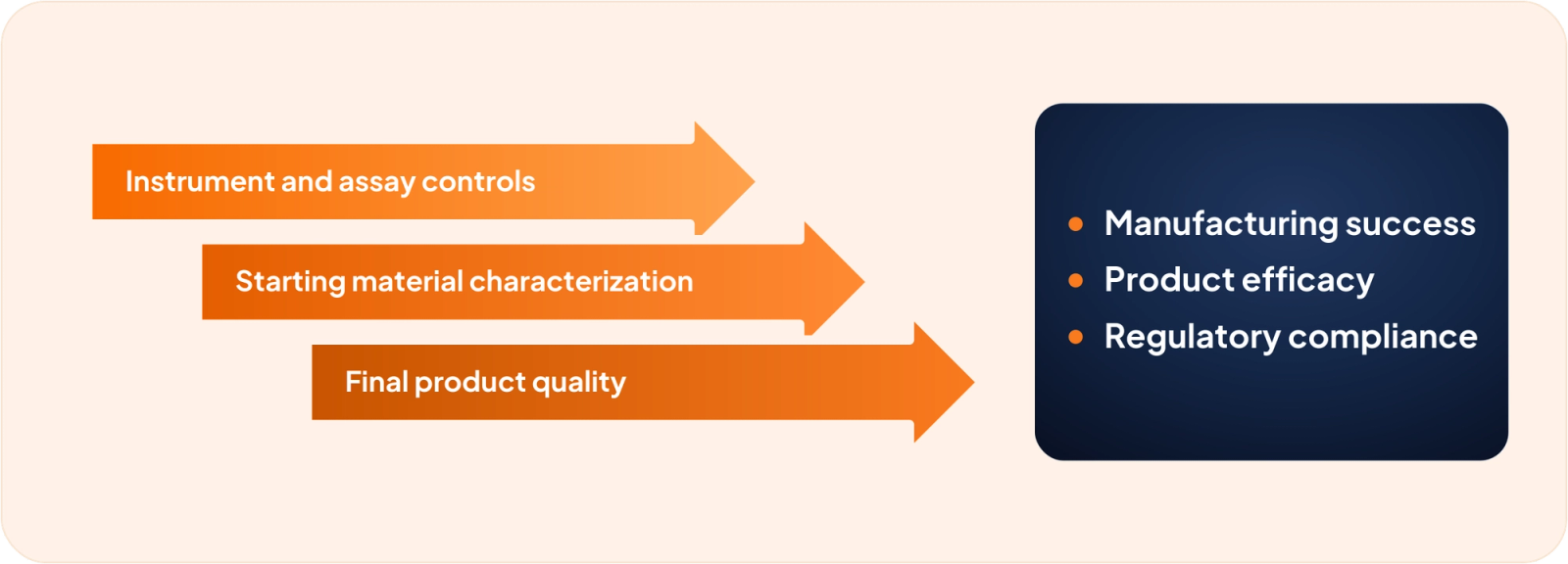
A major theme across these regulatory documents — and one that CLSI H62 reinforces — is the need to understand and control variability at each stage of the manufacturing process. This effort begins long before genetic modification or expansion steps; it starts with the cellular material entering the process itself.

Starting material is a primary source of product variability
Common starting materials in these advanced therapies are leukapheresis products from patients (autologous) or from healthy donors (allogeneic). These materials can vary substantially in composition from lot to lot, and that variability is a major driver of downstream differences in product function, manufacturability, and clinical performance.
For this reason, the CAR-T guidance encourages developers to assess the starting material for both viability and cellular composition — including monocytes, T cells, B cells, NK cells, and CD4+ and CD8+ T-cell subsets. These expectations set a high bar, and historically the field has struggled to meet it. A review of more than 600 registered CAR-T trials found that apheresis collection criteria are inconsistently defined and that composition parameters such as lymphocyte and CD3 counts are only variably reported (Thibodeaux et al., 2022).
The stakes of starting-material quality are well documented. Reviews of autologous CAR-T programs identify apheresis product quality as a predictive factor for both manufacturing success and clinical response, with manufacturing failure risk reaching 25% (Baguet et al., 2024). These findings emphasize why standardized, reproducible characterization of starting material is required not only for meeting regulatory expectations, but for ensuring consistent product quality and reducing the likelihood of costly manufacturing failures.
Flow cytometry is uniquely suited for characterizing both the health and the composition of leukapheresis materials, which makes reliable immunophenotyping controls foundational to a defensible analytical strategy. Yet this is precisely where a new challenge emerges: the controls themselves often lack the consistency, characterization, and stability required in regulated environments — a limitation rooted in the broader reference-standard gap that has long affected flow cytometry.
The reference-standard problem in flow cytometry
A persistent challenge in establishing flow cytometry assays has been the availability of suitable controls and reference materials. The July 2015 FDA guidance indicates that the qualification of each lot of a reference standard should be documented and included in annual reports. Where suitable USP or compendial standards exist they may be used instead — but for flow cytometry assays, such compendial standards do not yet exist.
That gap has historically left developers relying on biological materials — cell lines or manufactured product — to control their assays. The result is an endless cycle of testing, batch release, and reference-standard documentation for many of the flow cytometry assays that form part of the Chemistry, Manufacturing, and Controls (CMC) package. Every new lot of a biological control carries its own variability, its own qualification burden, and its own biohazard and handling considerations.
This challenge is widely recognized across the field. The CLSI H62 consensus guideline identifies the lack of suitable reference materials — and the absence of true calibration curves — as core factors that make cell-based assay validation fundamentally different from the biochemical, soluble-analyte methods regulators are accustomed to (CLSI H62, 2021). The guideline recognizes both bead-based and stabilized-cellular materials as viable quality-control options, but each comes with limitations in stability, consistency, or biological relevance.
More recently, synthetic cell mimics have expanded the toolkit available to development and manufacturing teams by combining bead-like stability and lot-to-lot reproducibility with the scatter and antigen-presentation behavior of real cells. These synthetic controls address the reference-standard gap that H62 highlights while providing a stable foundation for modern flow cytometry workflows.
Beyond starting material: synthetic capabilities across the CAR-T lifecycle
Flow cytometry supports far more than starting-material characterization; it underpins multiple analytical checkpoints across the CAR-T lifecycle. Synthetic reference materials extend this value by enabling quantitative antigen density measurements, providing defined expression levels that support LOD/LOQ determination, sensitivity studies, and quantitative method validation. In functional CAR-T benchmarking, synthetic targets help standardize potency and cytotoxicity readouts across sites, operators, and timepoints, reducing variability in assays that are otherwise difficult to harmonize.
When programs require markers or phenotypes without available commercial controls, custom biomarker cell mimics can be engineered to match novel CAR targets or rare-event populations, ensuring defensible characterization even in emerging or highly specialized assays. For compensation and spectral unmixing, SpectraComp® provides complementary single-stain controls that integrate seamlessly into spectral workflows.
Together, these capabilities reinforce the analytical rigor expected in CAR-T development and align with CLSI H62. The guideline underscores the importance of controlling assay variability across the full workflow, including post-examination steps such as data review, gating, and post-acquisition quality control.
Building on these principles, Slingshot Biosciences' TBNK Mimic™ demonstrates how synthetic cell mimics can serve as stable, reproducible reference materials for immunophenotyping both starting material and finished products across CAR-T development and manufacturing.
TBNK Mimic™: a synthetic reference material for composition and QC
TBNK Mimic™ (part of the PhenoCytes™ family of cell mimics) offers an elegant solution for documenting and standardizing flow cytometry assays used to assess the composition of cell therapy starting materials and manufactured products.
These lyophilized synthetic cell mimics contain well-defined populations that reflect physiologically relevant antigen densities, including CD4+ T cells (CD45+CD3+CD4+), CD8+ T cells (CD45+CD3+CD8+), B cells (CD45+CD3−CD19+), NK cells (CD45+CD3−CD16/56+), classical monocytes (CD45+CD14+), and granulocytes (CD45+CD16+). Their precision-engineered forward- and side-scatter profiles resemble the scatter characteristics of human peripheral blood populations, enabling confident population discrimination, gating, and quantification across cytometry platforms.
Because the mimic populations are incorporated into an assay following the same procedures as the cells being analyzed, they are suitable both as staining controls and for verification of instrument performance. As a fully synthetic, non-biohazardous material, TBNK Mimic™ requires no special handling or disposal — a practical advantage over primary cells and frozen preparations in a regulated environment.
The synthetic format also addresses the reference-standard burden directly. TBNK Mimic™ offers a multi-year shelf life and is produced in large, uniform manufacturing lots, substantially reducing the cost and effort of qualifying successive lots relative to biological materials. A peer-reviewed analytical validation reported ≤5% CV for intra- and inter-assay precision, linearity of R>0.998, and <5% drift under accelerated stability testing (Gunturu et al., 2026). A supporting application note describes its use as a reliable alternative to PBMC controls for consistent immunophenotyping.
Collectively, these features allow TBNK Mimic™ to support reliable, repeatable immunophenotyping across development and manufacturing, providing the level of analytical consistency that CMC workflows increasingly require.
Stay Updated
Subscribe to receive product updates, new resources, webinars, and application notes.